
Choosing a Case Type for Consultation, Workshops, and Groups
Choose the PracticeRunner case type that matches individual consultation, consultation groups, workshops, therapy groups, and relational therapy.
Choose the case type from the service being provided. A person’s role in one case does not determine their role everywhere else in the practice.
For example, the same person might receive individual therapy, participate in a professional consultation group, and attend a workshop. Keep those as separate cases so each service has the appropriate language, notes, forms, billing, and privacy boundaries.
Quick guide
| Case type | Use it when | Notes | Therapy and insurance tools |
|---|---|---|---|
| Individual therapy | One person receives psychotherapy | Progress notes or other configured clinical notes | Available when configured |
| Couple or family | Psychotherapy is organized around a relationship or family | Shared case notes, with participant-specific information kept separate when needed | Available when configured |
| Therapy group | Several people receive psychotherapy together | Group clinical notes and participant attendance | Available when configured |
| Individual consultation | One clinician or professional receives consultation or supervision | Consultation notes | Hidden by default |
| Consultation group | Several clinicians or professionals receive consultation or supervision together | Group consultation notes and participant attendance | Hidden by default |
| Workshop / skills group | Participants attend a training, class, coaching group, parent-education group, or other non-therapy group service | Group or session notes and participant attendance | Hidden by default |
Start with what the service is
- Choose Individual consultation when one professional receives consultation, practice consulting, or one-to-one supervision.
- Choose Consultation group when several professionals receive consultation or supervision together.
- Choose Workshop / skills group for a training, class, coaching group, relationship-skills workshop, parent-education group, or another group-format service that is neither psychotherapy nor professional consultation.
- Choose Therapy group when the group is providing psychotherapy.
- Choose an Individual, Couple, or Family case when the psychotherapy is organized around one person or a shared relationship.
When a label could describe several services, look at what participants are receiving. A group of therapists attending a business workshop belongs in a workshop group. A group of therapists discussing clinical work with a consultant belongs in a consultation group. A group receiving psychotherapy belongs in a therapy group.
What consultation looks like
Individual and group consultation have the operational tools needed for professional services: scheduling, Session Workspace, consultation notes, secure communication, consultation-specific agreements or forms, invoices, payments, receipts, and portal access when appropriate.
They do not show diagnoses, treatment plans, insurance claims, therapy intake prompts, or superbills by default. The participant is a consultation client, not a psychotherapy client or patient in that case.
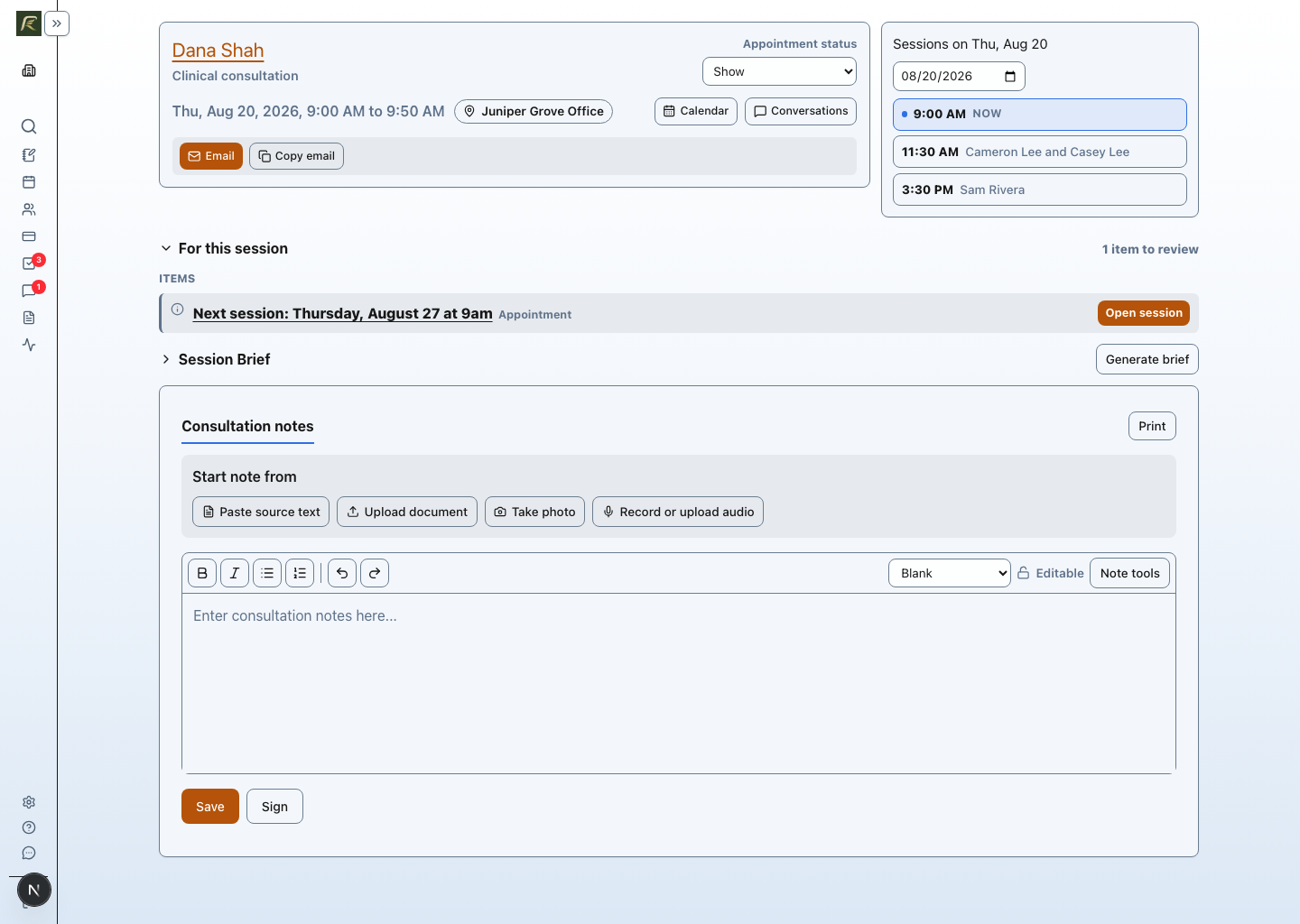
For setup instructions, see Individual Consultation and Group Consultation.
What a workshop or skills group looks like
A workshop group is a persistent case, not only a calendar event. It keeps the participant roster, appointment series, attendance, shared materials, messages, invoices, receipts, and group notes together.
Workshop participants can be existing therapy clients, consultation clients, or people who only attend the workshop. Their participation in the workshop does not change the nature of another case. Use workshop-specific agreements, registration forms, handouts, or payment authorizations instead of a psychotherapy intake packet.
For setup instructions, see Workshop and Skills Groups.
How relational therapy differs
Couple, family, and therapy-group cases also keep several people connected over time, but they represent psychotherapy. Their configured workflows can include diagnoses, treatment plans, insurance-ready services, claims, and superbills when those tools apply.
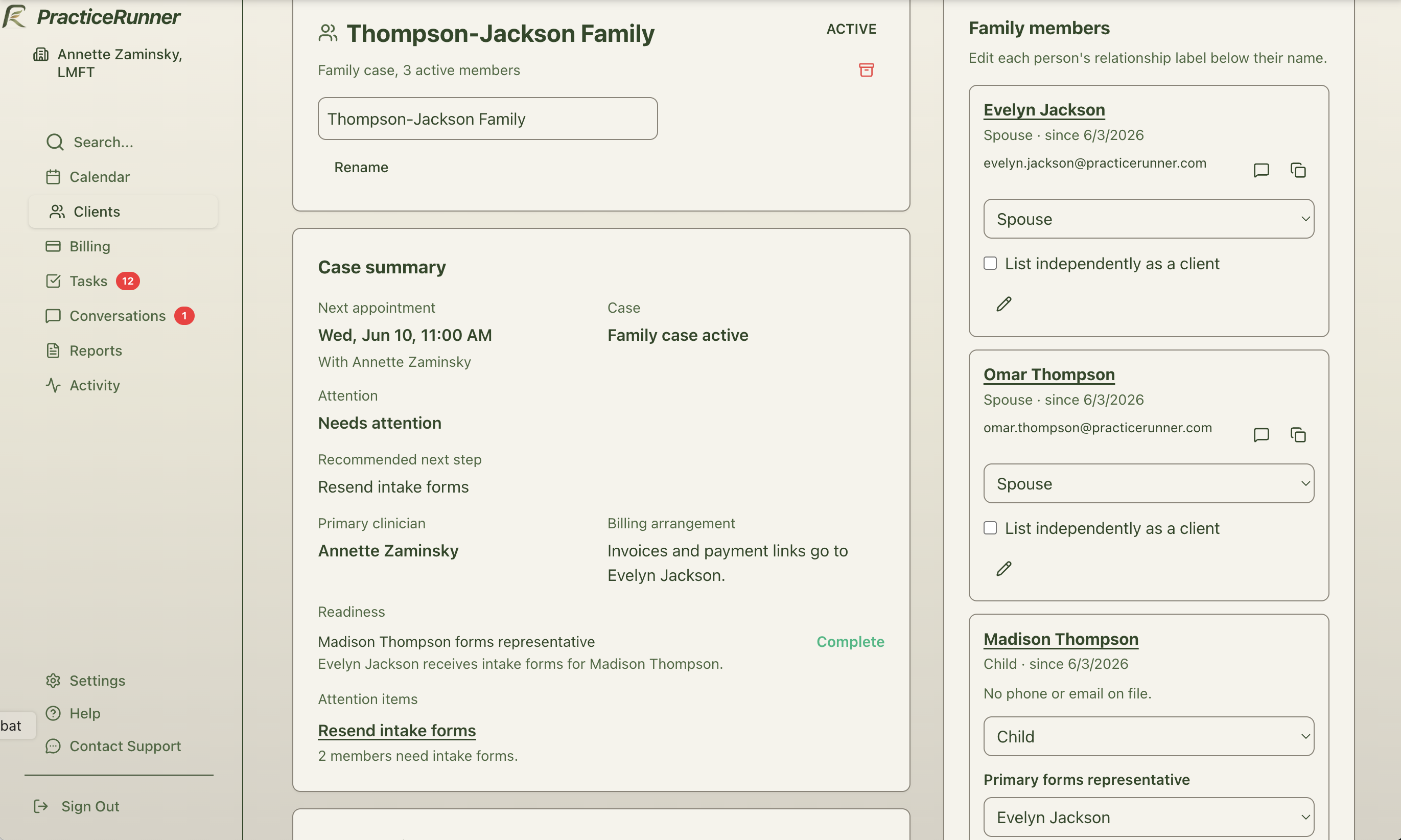
The same case structure supports relational therapy and non-therapy services, but it does not make them interchangeable. For more about relational cases, see Practice Management for Couples, Families, and Groups.
Capabilities by case type
| Capability | Individual consultation | Consultation group | Workshop / skills group | Therapy group | Couple or family |
|---|---|---|---|---|---|
| Persistent participant relationship | One consultation client | Several consultation clients | Several workshop participants | Several therapy clients | Couple or family participants |
| Participant attendance | Appointment attendance | Yes | Yes | Yes | Yes, when needed |
| Scheduling and recurring appointments | Yes | Yes | Yes | Yes | Yes |
| Notes | Consultation notes | Group consultation notes | Group or session notes | Clinical group notes | Clinical case notes |
| Invoices, payments, and receipts | Yes | Yes | Yes | Yes | Yes |
| Documents and forms | Consultation-specific | Consultation-specific | Workshop-specific | Therapy-specific | Therapy-specific |
| Portal and secure communication | When configured | When configured by participant or billing contact | When configured by participant or billing contact | When configured | When configured by participant or billing contact |
| Diagnoses and treatment plans | Hidden by default | Hidden by default | Hidden by default | Available when configured | Available when configured |
| Insurance claims and superbills | Hidden by default | Hidden by default | Hidden by default | Available when configured | Available when configured |
Billing follows responsibility
The person participating is not always the person paying. Depending on the case, billing can go to the participant, another approved billing contact, or a sponsoring organization when configured.
Consultation and workshop cases use invoices and receipts by default. Do not add artificial procedure codes or create superbills for services that are not psychotherapy. Use Consultation service for consultation and supervision. Use Workshop, class, or non-clinical service for workshops and classes.
If a person’s role changes
Create the case that matches the new service instead of changing an existing case into something it is not. A consultation client who begins psychotherapy should have a separate therapy case. A therapy client who joins a workshop can be added to the workshop group while their therapy case remains separate.
This keeps appointments, documentation, agreements, communication, billing, and access aligned with the relationship in which they belong.